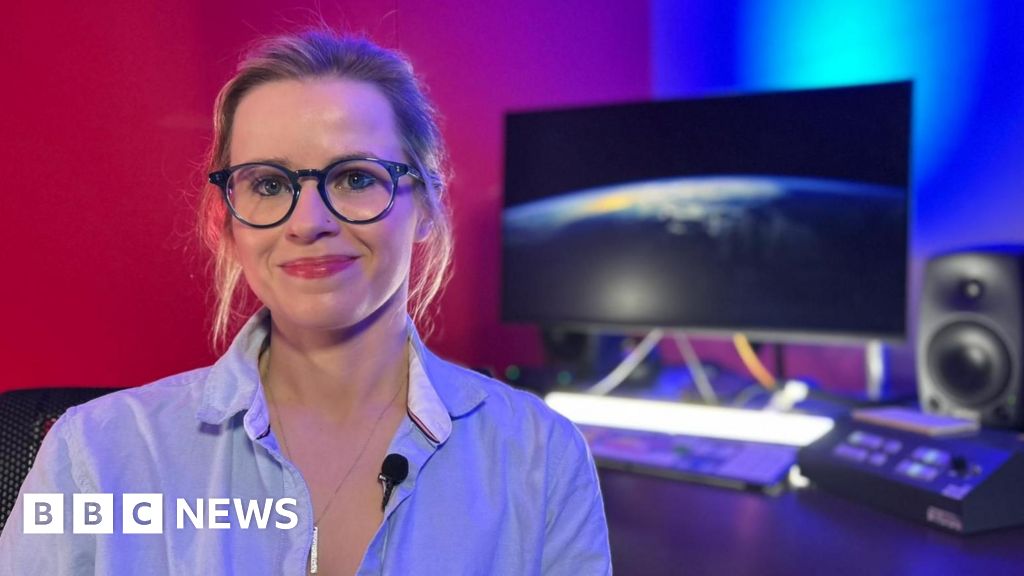
Interstellar A&E: The Scottish doctor of space medicine
BBC News Scienceen
When emergencies happen in space, there are no hospitals, no ambulances, and often no doctors on hand. Bridging this critical gap is Scottish medic Dr Christina Mackaill, who divides her time between working as an A&E doctor in Glasgow and serving as an expert in space medicine for Nasa. Mackaill has dedicated her career to ensuring astronauts remain medically safe both in orbit and upon their return to Earth, while also educating emergency departments worldwide about the severe impacts space travel can have on the human body.
"Aviation and space medicine is a growing speciality and it is going to become bigger and bigger as more people go into space," Mackaill says.
The Edinburgh-born doctor founded Scotland's first space medicine society in 2016 after developing an interest in the field during her university studies. Her first major project took her to Brazil, where she collaborated with physician and space expert Dr Thais Russomano. Together, they tackled a uniquely extraterrestrial challenge: performing life-saving CPR in environments with lower gravity. While previous research had focused on microgravity conditions like those on the International Space Station (ISS), the duo pioneered a method for performing CPR on the moon and Mars.
The resulting Mackaill-Russomano method teaches astronauts how to maintain stability and deliver effective chest compressions despite reduced body weight, a technique she has since presented to both Nasa and the European Space Agency. As space agencies plan missions further into the cosmos, Mackaill emphasizes that basic life-saving skills are no longer optional for crews. While a medical evacuation might be feasible for the ISS, venturing to the moon or Mars means astronauts must possess broad medical capabilities, including surgical skills.
A major part of preparing for these journeys involves understanding how lower gravity fundamentally alters human physiology. "Depending on how long you are in space, there are a lot of different changes that happen to the body," she told BBC Scotland News. "Fluid from the lower body can shift upwards during missions because there is no gravity, and muscle mass and bone density can decrease as they are not weight bearing." "If astronauts are up in space for a couple of months, the fluid shifts can even put pressure on the back of the eyes and cause visual changes."
To address these dangers, Mackaill is currently working with Nasa's chief health and medical officer Dr James Polk to develop clinical guidelines for terrestrial doctors treating returning astronauts. "Astronauts lose about 15% of their circulating plasma volume, which means when they come back, their blood pressure can drop and they might need additional fluids," she says. "If they had trauma coming back and came into hospital, the astronauts could require blood products quicker or be at an increased risk of fractures."
With missions like Artemis II pushing human boundaries deeper into space, the threat of radiation exposure and solar flares adds another layer of medical complexity. "Astronauts' immune systems could be affected from the radiation, which can lead to viruses, such as glandular fever, when they come back," Mackaill says. "It's important to know about the physiological changes because doctors could do harm if they are not aware of how astronauts physiology changes in space with the amount of fluid in their body, their immune system or their risk of fracture."
As commercial space flights transition from science fiction to reality, Mackaill warns that the medical landscape is shifting. "Astronauts are screened very meticulously before going to space but with commercial flights, these people are paying to go so the medical screening will likely be much less," she says. "It is a lot about preventive medicine just now because there are limited medical supplies in space but with commercial flights, there could be a higher medical risk."
Despite the hazards, nearly a decade of research and the recent success of the Artemis II mission have only fueled her personal aspirations. "Watching the Artemis crew, who have been to space several times, and seeing how overwhelmed they are at the images of the Earth and the moon, it's unbelievable. " "I don't think I would be keen on going to Mars but the moon, definitely, I think it would be so cool."
Source: BBC News Science
Related articles

Butterfly numbers are dropping but here are five species you may see more of
The UK Butterfly Monitoring Scheme's 50-year dataset reveals a widening gap between adaptable butterfly species flourish…
BBC News Science
New footage shows joy at Orion capsule hatch being opened
Newly released video captures the jubilant reaction of mission control as NASA successfully opened the hatch of the Orio…
BBC News Science
New footage shows moment Orion capsule hatch is opened at sea
Newly released footage shows the moment recovery crews opened the Orion capsule hatch at sea, reuniting safely with astr…
BBC News Science
Watch: Moment meteor soars across Suffolk sky
A meteor was captured on a home security camera streaking across the Suffolk sky in the early hours of Monday morning. T…
BBC News Science

Raw sewage posters at lough not official, says minister
Misleading warning posters claiming Belfast Lough is highly contaminated with raw sewage have appeared along the County …
BBC News Science