Fines issued after fuel protests across NI disrupt traffic
BBC News Businessen
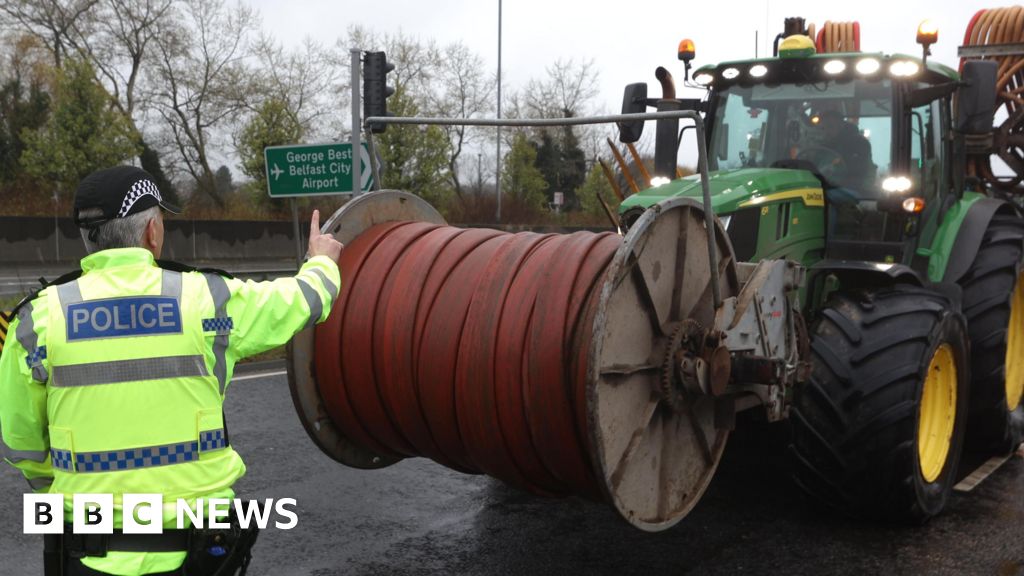
Fines have been issued and cautions handed out for public order offences after fuel protests caused significant traffic disruption across Northern Ireland, with farmers and hauliers demanding action over soaring energy costs linked to the US-Israel war with Iran.
The Police Service of Northern Ireland (PSNI) carried out a major policing operation on Tuesday to deal with slow-moving vehicle demonstrations at the Sydenham Bypass, Westlink, M2, A1, A4, A5 and a blockade of the A6 at Toome. Some passengers heading to Belfast City Airport were forced to pull their luggage along the side of the road as the Sydenham bypass was brought to a standstill.
Ch Supt Norman Haslett said the PSNI will be reviewing footage taken during the operation in order to consider further prosecution for any potential offences. In a statement, he said the policing operation was designed to "minimise disruption" to the road network and to "prevent escalation and prolonged disruption". "The right to freedom of speech and freedom of assembly are fundamental human rights which are protected in law and allow individuals to engage in peaceful protest. "However, these rights are balanced by the need to uphold the rights of others, protect public health and safety, minimise disruption to normal life and by the need to prevent and detect crime,"" he added.
In Ballygawley, County Tyrone, up to 40 tractors and trucks continued a convoy moving between the Ballygawley roundabout and the A4 Enniskillen roundabout late into Tuesday night. Vehicles including tractors, lorries and slurry tankers occasionally honked their horns as a handful of bystanders watched on.
Farmer Dermot O'Donnell, who was at the protest in Ballygawley, said he wants fuel prices lowered and called for more people to come out and support them. "Even the police are trying to get us away from a civil protest, it just goes to show you how much the country has flipped," he said. "If we all stick together we might get something down, the price of diesel or something will come down which might help everybody."
Farmer Stephen McKeown, who was also at the protest in Ballygawley, said he would rather be at home working but felt he had to take a stand. "We are sick and tired of the cost of everything at the present time," he said. "I don't mind paying tax but I really do detest when my money is being spent very foolishly." He hoped Stormont would see how unhappy people were with spiralling costs, and "spend money more wisely".
Ballygowan farmer Sam Hanna, who took part in the Sydenham bypass protest with his dog Roy, apologised for any disruption but said "we're doing it for them". "It's not just for the farmer, it's for the ordinary housewife going in and getting her shopping, putting £20 or £40 or diesel or petrol into her car," he said. "Fuel is not really that dear if you take the tax off it. We have money for everything else – we can spend overseas, we can help people coming to this country, we can't help our own people."
The protests come as fuel costs have soared globally following the closure of the Strait of Hormuz, which has halted approximately 20% of the world's oil trade. In Northern Ireland, petrol increased from 124.8p per litre on 26 February to 153.1p per litre on Thursday, while diesel prices have risen from 132.6p per litre to 185.6p per litre, according to the Consumer Council.
First Minister Michelle O'Neill called on Sir Keir Starmer to act, writing on social media: "Over half of what people pay at the pump is tax," she said. "Only the British government has the power to cut this tax, but Keir Starmer is choosing not to act."
Infrastructure Minister Liz Kimmins said the protests were indicative of "frustration" over increasing costs. "People feel like they're pinned to their collars here with the rising fuel prices," she told the BBC's Evening Extra programme. "It's having an impact on their ability to do their jobs, to put food on their tables, to put food on all of our tables actually." She said she had frozen fares on public transport and ministers were looking across executive departments to see what else could be done to help consumers.
Health Minister Mike Nesbitt urged people not to block roads and to let healthcare workers reach their patients, adding that "disruption threatens life".
DUP leader Gavin Robinson said he did not want to see any disruption to emergency services or medical appointments. "In Dublin the protests were targeted at a government who have levers at their disposal," he said. "Whilst I understand and support people's right to protest, it is important to reflect at this stage that I don't think we would benefit from widespread disruption."
The Northern Ireland protests follow nearly a week of similar action in the Republic of Ireland, where demonstrators have been blocking fuel depots and motorways, leaving hundreds of petrol stations without fuel. On Sunday, the Irish government announced a €505m (£440m) package to support those most affected by rising fuel costs, on top of measures worth €250m announced almost three weeks ago.
The first and deputy first minister have sent a joint letter to the prime minister calling for the government to intervene on rising costs.
Source: BBC News Business
Related articles
Help to Buy mostly helped high earners, IFS says
An Institute for Fiscal Studies report reveals that England's Help to Buy scheme primarily benefited higher earners in c…
BBC News Business
Households could get free electricity for doing washing on sunny weekends
Households and businesses in Britain could receive free or discounted electricity for using appliances during periods of…
BBC News Business
Amazon to spend $11bn on satellite firm in growing Starlink rivalry
Amazon announced an $11.57 billion deal to acquire satellite firm Globalstar, marking a major escalation in its rivalry …
BBC News Business
Customers failed over outages, water boss tells MPs
South East Water's chairman has admitted the utility "failed on the basic objective of delivering water" after severe wi…
BBC News Business
How many ships are crossing the Strait of Hormuz?
At least four vessels with links to Iran have crossed the Strait of Hormuz despite a newly implemented US naval blockade…
BBC News Business