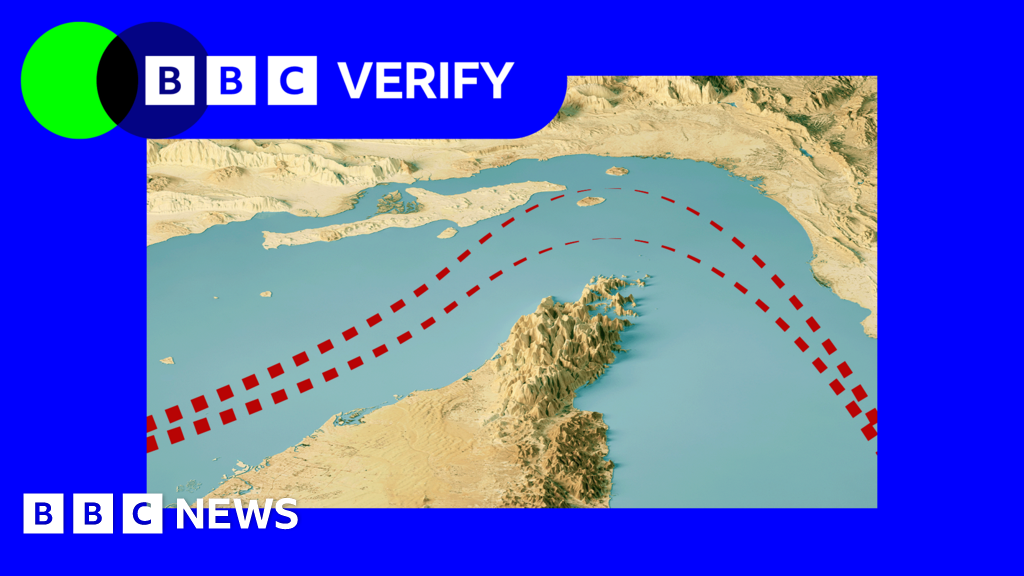
How many ships are crossing the Strait of Hormuz?
BBC News Businessen
At least four vessels with links to Iran have crossed the Strait of Hormuz despite the start of a US naval blockade, according to ship-tracking data, complicating Washington's efforts to control the critical waterway amid the ongoing US-Israel war with Iran.
MarineTraffic data analyzed by BBC Verify shows that while four Iranian-linked vessels initially sailed through the strait, at least two appear to have reversed course. The US-sanctioned tanker Rich Starry, which reported carrying cargo, sailed east from Sharjah in the UAE overnight but has since changed direction. Similarly, the bulk carrier Christianna, which transited east from Bandar Iman Khomeini in Iran on Monday, has also turned back. Another US-sanctioned tanker, the Elpis, transited the strait on Tuesday from the direction of the Iranian port of Bushehr but remained stationary on the eastern side by Tuesday evening.
These movements seemingly contradict claims from US Central Command, which stated on Tuesday that six vessels had complied with US orders to turn around and that "no ships from Iranian ports made it past the blockade". Meanwhile, tracking data indicates two Iranian-flagged ships—the cargo ship Ashkan3 and the container ship Shabdis—departed from near Iran's Chahbahar port on Tuesday, traveling more than 500km (310 miles) out of Iranian waters. However, the true locations of vessels in the region remain clouded by the possibility that some may have been "spoofing" their location signals or submitting incomplete data.
At least four additional vessels with no obvious links to Iran have also crossed the strait since the blockade began on Monday. The Strait of Hormuz has become the primary flashpoint in the conflict after Tehran effectively choked off one of the world’s most important shipping lanes. President Donald Trump stated the US blockade was enacted in response to Iran "knowingly failing" to reopen the strait. He also warned the US Navy will "blow to hell" any Iranians that attack them and will take action against any ship found to be paying transit tolls to Iran. Prior to the conflict, an average of 138 ships passed through the strait daily, a figure that has plummeted since fighting began six weeks ago, sending shock waves through global energy prices and exposing international supply chain vulnerabilities.
BBC Verify tracked 18 vessels transiting the strait between the breakdown of ceasefire talks and Trump's blockade announcement on Sunday evening, with at least 16 appearing to have links to Iran. As the standoff continues, industry leaders are warning of severe consequences. Jakob Larsen from the Baltic and International Maritime Council, which represents shipowners, told BBC Verify that he is concerned about the "risk of further escalation to involve direct attacks on ships" with the introduction of the US blockade. Experts note that if crossings resume at a greater pace for non-Iranian ships, stranded tankers will take priority. "You've had nearly 800 ships stuck in there for several weeks. Most of them are now loaded with cargo so the priority is going to be to get them out," said Richard Meade, editor-in-chief of Lloyd's List.
Complicating the resumption of normal traffic is the threat of sea mines. BBC Verify’s analysis shows ships that have passed the strait recently are taking a northerly route close to Iran's coastline and within its territorial waters, a stark departure from the pre-conflict norm of sailing down the middle of the waterway. Iran's Islamic Revolutionary Guard Corps (IRGC) Navy has published permitted routes through the strait "to avoid possible collision with sea mines", marking the central channel as a "dangerous area". Centcom has announced that two destroyers—the USS Frank E Petersen and USS Michael Murphy—are in the area on a mission to clear "sea mines previously laid by Iran's Islamic Revolutionary Guards Corps". Addressing the broader dangers, Thomas Kazakos, secretary general of the International Chamber of Shipping, told BBC Verify: "We need to make sure that we have clear confirmation that the safety of navigation for the ships and the seafarers are being agreed,"
Source: BBC News Business
Related articles

Help to Buy mostly helped high earners, IFS says
An Institute for Fiscal Studies report reveals that England's Help to Buy scheme primarily benefited higher earners in c…
BBC News Business
Fines issued after fuel protests across NI disrupt traffic
Fines have been issued after fuel protests caused traffic disruption across Northern Ireland, with slow-moving convoys o…
BBC News Business

Households could get free electricity for doing washing on sunny weekends
Households and businesses in Britain could receive free or discounted electricity for using appliances during periods of…
BBC News Business
Amazon to spend $11bn on satellite firm in growing Starlink rivalry
Amazon announced an $11.57 billion deal to acquire satellite firm Globalstar, marking a major escalation in its rivalry …
BBC News Business

Customers failed over outages, water boss tells MPs
South East Water's chairman has admitted the utility "failed on the basic objective of delivering water" after severe wi…
BBC News Business